
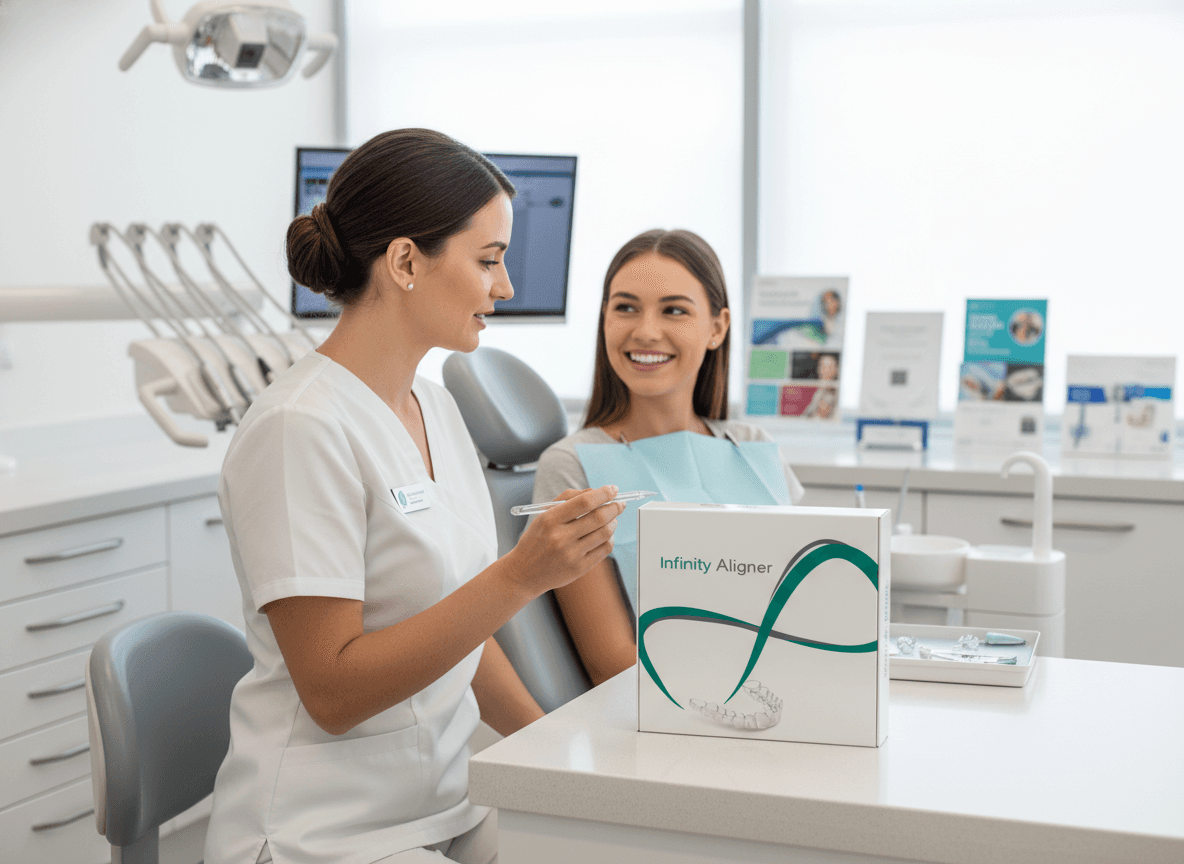
What a clear aligner actually is
An aligner is a transparent medical-grade plastic tray, custom thermoformed from a digital scan of your teeth. A series of successive aligners (10 to 40 depending on the case), worn 20 to 22 hours a day and changed every 1-2 weeks, gradually moves teeth toward the position validated on your 3D treatment plan. Unlike braces, nothing is bonded to the teeth: the aligner comes out to eat and brush.
Why Infinity Aligner became the reference in Tunisia
Infinity Aligner is a clear aligner brand manufactured in Tunisia, using certified medical-grade materials and a 3D treatment plan validated by a practitioner before every fabrication. Tunisia Smile chose to work exclusively with this brand — not out of commercial exclusivity, but because it's the only one combining local manufacturing (short turnaround, simpler follow-up), materials on par with international brands, and a genuinely demanding provider certification program. Our orthodontist, Dr Safa, is an Infinity Aligner certified provider.
The treatment process, step by step
Step 1: 3D digital scan of your mouth (intra-oral scanner, no messy putty impressions). Step 2: the Infinity Aligner provider designs a virtual treatment plan — you see the final result before even starting. Step 3: plan validation and fabrication of the full aligner series. Step 4: wearing the aligners with regular changes and spaced check-ups (in person during your stays, or remotely by photo between visits). Step 5: a retainer at the end of treatment to stabilize the result.
How long, how many trips
A simple case (mild crowding, gap) is treated in 4 to 8 months with 10 to 20 aligners. A more complex case can take 12-18 months. Most international patients come for a first trip (scan + plan validation), then receive their successive aligners with remote photo follow-up, and return for a mid-course check and a final visit for the retainer — two to three trips total across the whole treatment.
The real price, Tunisia vs Europe
A complete Infinity Aligner treatment costs between €1,490 and €2,400 in Tunisia, all-inclusive (scans, 3D plan, full aligner series, retainer, follow-up). The same treatment in France, Belgium or Switzerland runs €3,500 to €6,000 — a 58% average gap. The difference doesn't come from cheaper materials: it comes from structural and labor costs, not the quality of the medical-grade plastic used.
Infinity Aligner versus other aligner brands
Major international aligner brands are solid, but their centralized manufacturing abroad extends production timelines and complicates follow-up for a patient living in Europe and treated in Tunisia. Locally manufactured Infinity Aligner allows a faster turnaround between plan validation and aligner delivery, clinical follow-up in your language directly with the team that designed your plan, and manufacturing costs that benefit the patient directly rather than customs and intercontinental shipping fees.
Who is really a candidate for aligners
Mild to moderate crowding, gaps between teeth, slight jaw misalignment: aligners excel here. For very complex cases (severe rotations, major jaw discrepancies), a traditional fixed appliance is sometimes still more appropriate — which is exactly the point of the initial 3D scan, which objectively determines whether you're a candidate before any financial commitment.
Infinity Aligner isn't just "one brand among others" for Tunisia Smile — it's the only one we validate, because it combines local manufacturing, certified materials, and a real provider certification program. A 3D scan is enough to know if you're a candidate and see your final smile before starting.